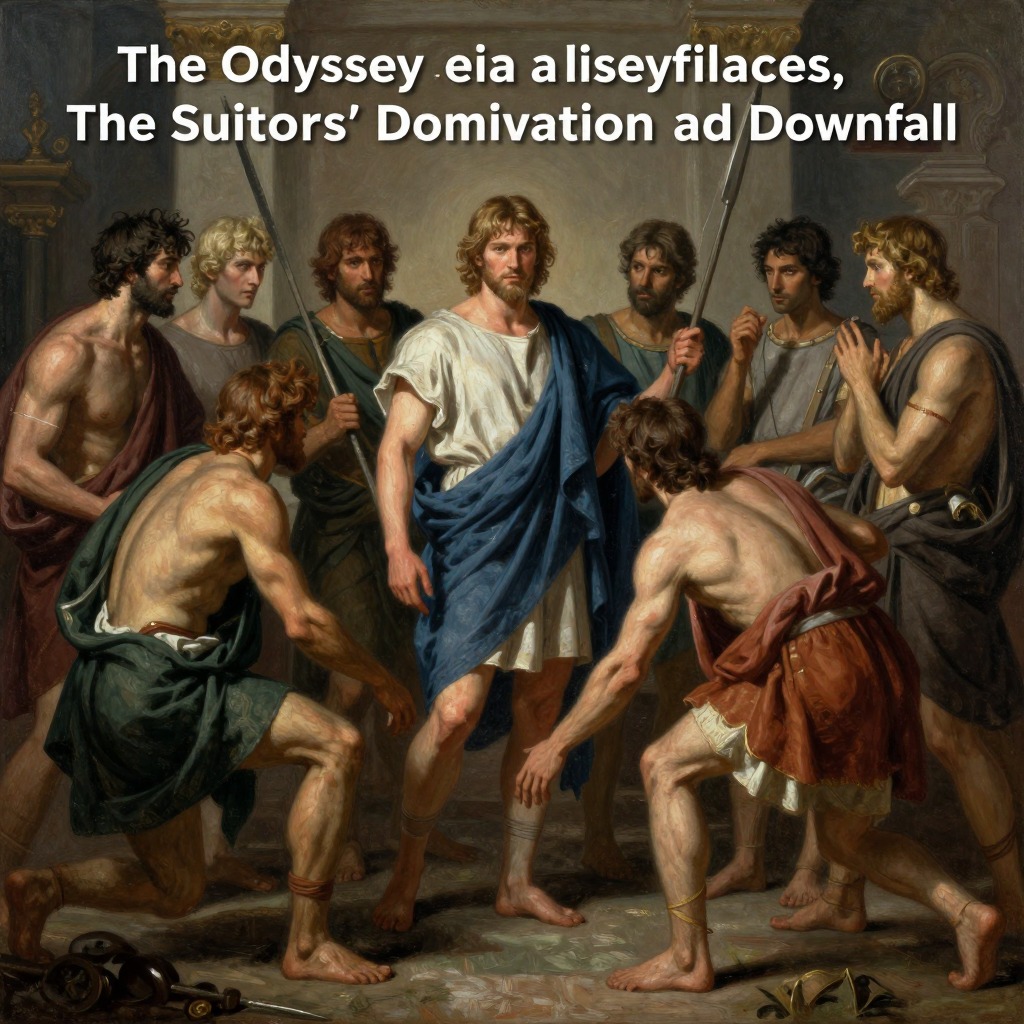
Melantho
Melantho is one of the maidservants in the household of Odysseus on Ithaca. She is the daughter of Dolius, the old gardener given to Penelope by her father Icarius upon her marriage, but she was brought up by Penelope herself, who gave her toys to play with and looked after her when she was a child. Despite this upbringing, Melantho shows no consideration for the sorrows of her mistress and habitually misconducts herself with Eurymachus, one of the leading suitors, with whom she is in love.
Identity and Background
Melantho is the daughter of Dolius, a trusted servant of the household. Penelope raised her from childhood, treating her with a kindness that should have inspired loyalty. Yet Melantho grows into a woman who flouts the authority of her mistress and aligns herself with the men who are consuming Odysseus's estate. Her brother Melanthius, the goatherd, similarly betrays the household by siding with the suitors, suggesting a family pattern of disloyalty.
Behavior Toward the Disguised Odysseus
When Odysseus, disguised as an old beggar, takes his place in the hall, Melantho becomes one of his most persistent tormentors. On the evening after the fight with Irus, as the maids hold up torches to light the banqueting hall, Odysseus offers to hold the light himself and tells the maids to go inside to their mistress. Melantho laughs at him and begins to gibe at him contemptuously. She calls him a wretch who has lost his wits, tells him to go sleep in a smithy or a place of public gossips, and asks if the wine has gotten into his head. She taunts him that he seems to have lost his senses because he beat the tramp Irus, and warns him that a better man than Irus may come and cudgel him bloody out of the house. Odysseus scowls at her and threatens to tell Telemachus what she has said, promising that Telemachus will have her torn limb from limb. This threat frightens Melantho and the other women, and they tremble as they go off into the body of the house.
Later that same night, after Penelope has come down to question the stranger, Melantho rails at Odysseus a second time. She asks if he means to plague them by hanging about the house all night and spying on the women, and tells him to be off outside and eat his supper there or be driven out with a firebrand. Odysseus again rebukes her, warning that she may lose the pride and place in which she now wantons above her fellows, and that Telemachus is now old enough to note anything done amiss by the maids. Penelope overhears and scolds Melantho, calling her an impudent baggage and saying she will smart for her behavior.
Relationship with Eurymachus
Melantho is in love with Eurymachus, one of the most prominent and aggressive suitors. Her misconduct with him is part of the broader pattern of the suitors' abuse of the household, as they force the women servants to lie with them. This relationship places Melantho squarely among those who have betrayed Odysseus's house from within, and it aligns her interests with the suitors rather than with her mistress.
Fate
After the slaughter of the suitors, Odysseus orders Euryclea to identify the women who have misconducted themselves. Euryclea reports that twelve of the fifty women in the house have been disloyal, showing disrespect to her and to Penelope. Odysseus commands that these women be made to help remove the dead and clean the hall, and then be taken outside and executed. Telemachus, rather than allowing them a clean death by the sword, has a ship's cable fastened to a bearing-post and the women are hanged in a row, their feet convulsing for a while before they die. Melantho, as one of the twelve, meets this end. Her brother Melanthius is also captured, mutilated, and left to die. The entire branch of Dolius's family that sided with the suitors is thus eliminated.
Thematic Significance
Melantho serves as a foil to the loyal servants Eumaeus and Philoetius, and as a negative counterpart to Penelope's fidelity. She embodies the corruption that the suitors have introduced into Odysseus's household, a corruption that penetrates even into the servant class. Her betrayal is particularly pointed because Penelope raised her with care, making her ingratitude a personal as well as a domestic offense. Her death, alongside the other disloyal maids, completes the purification of the house, removing every trace of the suitors' influence before Odysseus can be reunited with Penelope.